Heavy Fiber Laser Sheet Metal Systems are designed for demanding metal fabrication where thick materials, high cutting capacity, and consistent processing are central requirements. Unlike conventional cutting methods, fiber laser systems use a concentrated laser beam to generate the energy needed to separate metal with controlled precision.
High-power laser technology has expanded the range of sheet and plate materials that can be processed efficiently. Improvements in laser sources, cutting heads, motion systems, and process control have also made these machines more adaptable to industrial production environments.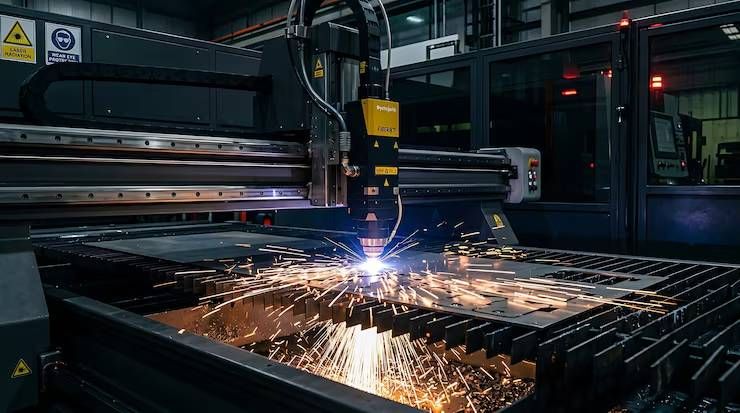
Understanding how these systems generate and control cutting energy helps explain where they fit in modern fabrication. Their capabilities depend not only on laser power, but also on material type, thickness, assist gas, optics, machine structure, and programmed cutting parameters.
How High-Power Fiber Laser Cutting Works
A fiber laser generates light through an optical fiber that has been engineered to amplify the laser signal. The resulting beam is directed through a delivery system toward the cutting head, where optics focus it into a highly concentrated point on the metal surface.
When the focused beam reaches sufficient energy density, it rapidly heats the material. Depending on the cutting process and material, the metal can melt or partially vaporize. An assist gas then helps remove the molten material from the kerf, creating the cut.
The cutting head moves along a programmed path while maintaining the appropriate focal position relative to the workpiece. Computer numerical control coordinates movement, laser output, gas flow, and other parameters to produce the intended geometry.
This combination of concentrated energy and controlled motion allows fiber laser systems to create complex profiles without requiring physical contact between the cutting tool and the sheet.
Why Higher Laser Power Matters for Heavy Materials
Laser power is one of the most visible specifications of an industrial cutting system, but its significance is more specific than simply making the machine "stronger."
Higher available power can increase the energy delivered to the cutting zone, which can support faster processing or greater material thickness within an appropriate process window. The actual result depends on the material and machine configuration.
For heavy sheet metal applications, higher power can be particularly useful when working with materials such as carbon steel, stainless steel, and aluminum. Thick sections generally require greater energy input and carefully controlled heat transfer to maintain stable cutting.
However, laser power alone does not determine performance. A high-power source paired with unsuitable optics, an inadequate cutting head, poor gas control, or insufficient machine rigidity may not deliver the expected results.
Key Components of a Heavy-Duty Laser System
A high-power sheet metal laser is an integrated production system rather than simply a laser source. Several components work together to control the cutting process.
The laser source generates the optical energy used for cutting. Fiber laser sources are widely used because they can provide high output power while maintaining a compact optical architecture.
The cutting head focuses the beam onto the material and typically incorporates protective optics, height sensing, and mechanisms for controlling the focal position.
The motion system moves the cutting head across the work area. Precision drives, guide systems, and structural rigidity influence positioning accuracy and repeatability.
The CNC controller translates programmed geometries into coordinated machine movements. Advanced control systems can adjust cutting parameters according to material type, thickness, geometry, and process requirements.
The assist-gas system supplies gases such as oxygen or nitrogen to the cutting zone. Gas selection and pressure can significantly influence cut quality, speed, edge condition, and material response.
Material Thickness Changes the Cutting Process
Heavy fiber laser cutting is not a single standardized operation. Processing conditions change significantly as material thickness increases.
Thin sheet can often be processed at relatively high speeds because less material needs to be heated and removed. As thickness increases, the cutting zone becomes more demanding. Heat transfer, molten-metal evacuation, beam focus, gas dynamics, and cutting speed become increasingly important.
For thick carbon steel, oxygen may be used to support the cutting reaction. Nitrogen is commonly associated with processes where oxidation of the cut edge needs to be minimized, particularly for stainless steel and certain aluminum applications.
The correct parameters depend on the particular material and machine. Operators typically consider factors such as:
- Material grade and thickness
- Laser power and beam characteristics
- Focal position
- Cutting speed
- Assist-gas type and pressure
- Nozzle configuration
- Piercing strategy
- Thermal behavior of the workpiece
These variables interact with one another, so changing one parameter can affect the overall cutting process.
Managing Heat and Cut Quality
High-power cutting introduces substantial thermal energy into the workpiece. Managing that energy is essential for maintaining dimensional accuracy and acceptable edge quality.
When the process is correctly balanced, the laser produces a narrow kerf and removes molten material efficiently. Poorly matched parameters can create excessive dross, rough edges, incomplete penetration, or heat-related distortion.
Piercing is another important consideration when processing heavy plate. The machine must establish a controlled opening before beginning the programmed contour. Thick materials can require more sophisticated piercing sequences because excessive energy concentration during the initial stage may damage the nozzle or create unstable cutting conditions.
Modern systems can use automated parameter libraries and sensing technologies to help maintain process stability. These functions reduce the amount of manual adjustment required, although skilled process supervision remains valuable for demanding applications.
Machine Design Matters as Much as Laser Output
Heavy-duty fabrication places different demands on machine construction than light sheet processing. The frame, worktable, drive components, cutting head, and thermal management system all need to operate reliably under demanding production conditions.
Machine rigidity is particularly relevant because vibration or mechanical movement can affect positioning accuracy and cut geometry. A robust structure helps maintain predictable movement while the cutting head travels across large workpieces.
Large-format systems may also incorporate automated material handling or interchangeable worktables. These features can reduce interruptions between cutting cycles and help integrate the machine into broader fabrication workflows.
For industrial environments, extraction and enclosure systems are also important. Cutting metal generates fumes, particulates, heat, and bright optical radiation, making appropriate guarding and ventilation part of responsible machine operation.
Where Heavy Fiber Laser Systems Are Used
High-power fiber laser systems can support a broad range of fabrication activities where large quantities of sheet or plate must be converted into accurately shaped components.
Common applications include structural components, industrial machinery parts, transportation equipment, agricultural machinery, enclosures, frames, and general metal fabrication.
The technology is particularly useful when production involves changing part geometries. A CNC-controlled laser can switch between programmed profiles without requiring a dedicated physical cutting die for every shape.
This flexibility can be valuable in environments where different component designs are processed on the same machine. It also allows digital part files to become direct inputs into the production workflow.
Fiber Laser Cutting Versus Conventional Processes
Fiber laser cutting is one option within a broader collection of industrial metal-cutting technologies. Plasma cutting, oxy-fuel cutting, waterjet cutting, and mechanical processes each have characteristics that may make them appropriate for particular materials or thickness ranges.
Oxy-fuel cutting, for example, has long been used for thick carbon-steel plate. Plasma can provide high cutting speeds across certain conductive materials and thicknesses. Waterjet cutting uses a cold cutting process and can handle materials that are difficult to process thermally.
Fiber lasers distinguish themselves through their combination of concentrated energy, CNC flexibility, narrow kerf formation, and suitability for automated production. Whether those characteristics provide an advantage depends on the specific material, thickness, geometry, tolerance requirements, and production workflow.
Operating Considerations for High-Power Systems
High-power laser equipment requires disciplined operation and maintenance. Optical components must remain clean and correctly aligned, while nozzles and protective windows require inspection because contamination can affect beam delivery.
Assist-gas systems also require attention. Inconsistent pressure, contamination, or incorrect gas selection can alter the cutting process and produce inconsistent results.
Operators must also follow the machine manufacturer's procedures for laser safety, electrical systems, ventilation, material handling, and maintenance. High-power industrial lasers are specialized equipment and should be operated only by appropriately trained personnel.
Preventive maintenance is equally important. Regular inspection of motion components, cutting heads, cooling systems, optics, gas delivery, and extraction equipment can help identify problems before they affect production quality.
Choosing the Right Cutting Configuration
Selecting a heavy fiber laser system involves more than choosing the highest available power. The appropriate configuration should reflect the actual production requirements.
Important considerations include the typical material grades, maximum thickness, sheet dimensions, expected production volume, required tolerances, part geometry, automation level, and available facility infrastructure.
A system optimized for occasional thick-plate work may have different requirements from one intended for continuous production of mixed-gauge sheet metal. Likewise, a large work envelope may be more important for some operations than maximum laser output.
The most effective configuration is therefore the one that matches the complete production process rather than a single headline specification.
Frequently Asked Questions
Can fiber lasers cut thick sheet metal?
Yes. High-power fiber laser systems are designed to process substantially thicker materials than lower-power configurations. The practical thickness range depends on laser power, material, assist gas, cutting head, machine configuration, and process parameters.
Does higher laser power always mean faster cutting?
No. Higher power can support faster cutting or thicker-material processing under suitable conditions, but speed also depends on material properties, thickness, gas parameters, focus, machine capability, and cutting strategy.
Which metals can fiber lasers process?
Fiber laser systems can process many industrial metals, including carbon steel, stainless steel, and aluminum. The appropriate process parameters vary considerably between materials.
Why is assist gas used during laser cutting?
Assist gas helps remove molten material from the cutting zone and influences the thermal and chemical conditions around the cut. Oxygen and nitrogen can produce different cutting characteristics depending on the application.
Is high-power laser cutting suitable for every fabrication operation?
No. Laser cutting should be evaluated against the material, thickness, geometry, tolerance requirements, production volume, and facility capabilities. Other cutting technologies may be more appropriate for certain applications.
Conclusion
Heavy Fiber Laser Sheet Metal Systems combine high-energy laser sources, precision optics, CNC motion, assist-gas control, and automated process management to handle demanding metal-cutting applications. Their performance depends on the complete system rather than laser power alone.
For heavy sheet and plate processing, factors such as material thickness, thermal behavior, gas selection, machine rigidity, cutting-head configuration, and process control all influence the final result. Understanding these relationships makes it easier to evaluate where high-power fiber laser technology fits within modern metal fabrication.